Friday, June 11, 2021

Diversity and Creativity - A Chicken-and-egg-situation?

Which came first - the chicken or the egg?  This is an example of an impossible question, one that was brought to my mind when I started thinking about the relationship between diversity and creativity: which influences the other more? 

Throughout PME 811 (Innovation in Teaching and Learning course), the value of creativity on innovation, teaching, and learning has been apparent. Society in general, views creativity in a positive light. Creativity can be viewed as a kind of diversity - a diversity of thought or a diversity of ideas, perhaps.  

Today's companies are focusing greater efforts in the area of diversity and inclusion for reasons beyond social justice - creativity can often result when diversity is represented at the table.  So I ask the impossible question:  which has the greater influence on the other: creativity or diversity?  Perhaps there is no merit in further exploring this question, but there is value in noting that it is beneficial for today's organizations and institutions to foster a culture that supports diversity and creativity.  


I created a GIF of three of my backyard chickens (two were named after Karate and Kung Fu legends, and have lived up to their names with their acrobatic antics). They're a good example of diverse and creative additions to our family!

PS - In case you're curious, upon later examination, I learned that someone has actually come up with a possible answer to the chicken-and-egg question. The egg came first, as it was created by two birds that weren't really chickens.  Read the full article here. 

Sources

Breyer, Melissa (2020). Finally Answered!  Which Came First, the Chicken or the Egg? from Treehugger.  Retrieved from: https://www.treehugger.com/finally-answered-which-came-first-the-chicken-or-the-egg-4864321

Meenasian, Sam (2020). How to Create a More Creative Workplace Through Flexibility, Diversity, and Inclusion.  HR Daily Advisor. Retrieved from: https://hrdailyadvisor.blr.com/2020/09/23/how-to-create-a-more-creative-workplace-through-flexibility-diversity-and-inclusion/  

What is Your Mission Statement?


I was asked to develop a philosophy statement for this week's assignment in PME 811 - Innovation in Teaching & Learning. This process proved to be quite valuable as it encouraged me to reflect on my personal philosophy of teaching and learning … and life.

My final product was a fairly general statement about how I value creativity and innovation and how these elements have a positive effect on teaching and learning, and encourage diversity and inclusion.  I noted that we should learn from history, but also challenge the assumptions we have about history - be revisionists!  We need to be mindful and self-aware, and present the conditions necessary for a beneficial learning environment. 

With further reading, I started to think about the value a personal philosophy of life would have for an individual.  It would be like a personal Mission Statement.  Organizations spend months and thousands of dollars in developing the right Mission Statement - this is to guide the work and daily decisions of every employee in the company in the right direction. With this in mind, wouldn't it be valuable to develop one's own set of philosophies to assist with life decisions - big and small?  

I looked for examples of corporate mission statements, and found some great ones here. Nike's Mission is: 

"To bring inspiration and innovation to every athlete in the world. If you have a body, you are an athlete.”
This guides all that they do at Nike and is consistent to every decision that is made throughout the organization.  There's a great 4-minute interview with Mark Parker, Nike CEO that you can listen to here.

With regard to a personal statement, maybe this is something you write in a journal, or on a post-it beside your computer monitor. Maybe it's a lengthy description.  Maybe it's just a few key words. Maybe it's a poem or song you resonate with, or a picture or infographic. However it materializes, I  think it's worth considering. Certainly there would be an investment of time required in reflecting and developing this statement, but it may pay off in the long run.


Sources

Chism, N. (998) Developing a Philosophy of Teaching Statement.  In Gillespie, K.H. (Ed) Essays on Teaching Excellence:  Toward the Best in the Academy (1997-98). POD NetworkL  A publication of the Professional and Organizational Development Network in Higher Education.

Davenport, Barrie (2020). 11 Best Personal Philosophies to Guide Your Life. Retrieved from: https://liveboldandbloom.com/09/values/personal-philosophy-examples

Morella-Olson, Melinda (2021). 31 Amazing (and a Few Awful) Company Mission Statement Examples You Can Sink Your Teeth Into. From Imaginasium: blog https://www.imaginasium.com/blog/mission-statement-examples

Friday, June 4, 2021

Three Guineas and the COVID-19 Pandemic

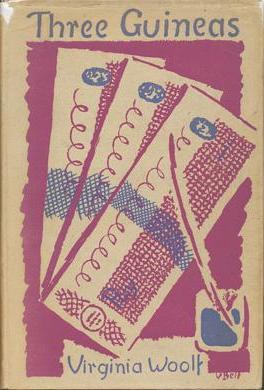
 This week, while reading one of the suggested articles on the topic of Diversity and Inclusion in Innovation and Creativity in Education, I was struck by a description cited in from Virginia Woolf's Three Guineas novel. 

Woolf describes a bridge in her book, which connects the private and public, home and professional workplaces - Woolf encourages women to stand on this bridge, "Behind us lies the patriarchal system; the private house, with its nullity, its immorality, its hypocrisy, its servility. Before us lies the public world, the professional system, with its possessiveness, its jealousy, its pugnacity, its greed.". Woolf 's writing is clearly a criticism of patriarchal systems and the challenges and choices women need to make.

 See the source image

 Fast forward to 2019, where as a woman I feel like the society I live in has come a long way since the 1930s when Woolf wrote these words.  These choices are not so definitive now, with modern conveniences, technology, and concepts such as daycare (!) that facilitate the choices women make between private professional lives. 

But have we come as far as we think?  The COVID-19 pandemic is showing the cracks in all of the progress we thought we had made, and it is especially evident when we look at working mothers. The burden of childcare and development, and maintaining a household has fallen disproportionately on women during the pandemic. 

In a recent article in the National Post, it was written that  "It's a mother-focused pandemic, as it's affecting mothers, more than women, more than fathers and more than men. Women are leaving the workforce at alarming rates, and it will have long-lasting consequences". I have experienced this with friends who have chosen to take time away from work to support their children and families during this challenging time, or facing suffering burnout while they care for children and elderly parents while maintaining a full-time job. In some cases, it feels like a push backward for mothers.

The National Post article discusses implications for the economy.  I wonder about the longterm effects for women in the workforce - both for the women and for the workforce.  This effect could have negative consequences that impact creativity and innovation as perspectives become less diverse in the workplace.


Sources 

Martin, J. R. (1991). The contradiction and the challenge of the educated woman. Women’s Studies Quarterly [Special Issue on Women, Girls, and the Culture of Education], 19(1/2), 6–27.

Shah, Zeenya. March 8, 2021. Experts fear the pandemic may have devastating effects on working moms. The National Post. From:  https://nationalpost.com/news/canada/experts-fear-the-pandemic-may-have-devastating-effects-on-working-moms?fbclid=IwAR2828nnaga6n18AhgrH2KllIwn60HlDVD4tuJ6MIYzIisk1owRHRQdIsmM 

Design Thinking in Education


What is Design Thinking?  Design thinking is a process for creative problem solving.

According to Ideou.com, design thinking has a human-centered core. It encourages organizations to focus on the people they're creating for, which leads to better products, services, and internal processes. When you sit down to create a solution for a business need, the first question should always be what's the human need behind it?

Stanford University is well-known for creativity and innovation. They have developed a Design Thinking Process that has been used to channel creativity to solve complex business problems. 

The process involves a series of steps, designed to remove biases and preconceptions, and create an environment ripe for innovation and creativity, then bring in some inspiration from the engineering world that is known for prototyping, testing and improving. Those steps are:  EMPATHIZE, DEFINE, IDEATE, PROTOTYPE, and TEST.


What is Design Thinking? – Agile Elephant making sense of digital  transformation

I wonder if there is a way to apply design-thinking concepts to education.  I started to look online, and yes, of course someone has already thought of this!  This presentation by students at Stanford do a great job of applying these concepts to K-12 education.

There could certainly be value for using this process as a tool, with a number of applications:

(1) professional development with teachers  

(2) development and adaptation of curriculum with design 

(3) development of assessments for research, evaluation and classroom use 


 Sources

 What is Design Thinking?  From: https://www.ideou.com/blogs/inspiration/what-is-design-thinking

 What is Design Thinking?  From: http://www.theagileelephant.com/what-is-design-thinking/

 Taking Design Thinking to Schools.  Web Presentation.  From: https://web.stanford.edu/dept/SUSE/taking-design/presentations/Taking-design-to-school.pdf


Sunday, May 30, 2021

Innovation and Hallelujah - Revisionist History by Malcolm Gladwell

15 Essential Things You Need to Know to Start Your Music Career

A few of this week's PME 811 readings referenced "revisionist perspectives" or "revisionism".  I was reminded of a podcast that has long been on my "to listen" list, but I've never gotten around to it. Malcolm Gladwell's Revisionist History podcast piqued my interest as I am a big fan of his books The Tipping Point, Blink, and Outliers.

I listened to "Hallelujah" from season one. In this podcast, Gladwell notes that art lover David Gallenson indicates there are two types of innovators

Conceptual Innovators - Those who have meticulously planned and work quickly, have specific ideas, and execute. Example Picasso.  Exemplifies what most people consider when they think of "genius".

Experimental Innovators - Those who never have a clear idea, work by trial and error, do endless drafts, work slowly, take a lifetime to create. Example Cezanne - who was known for 

Gladwell talks about the famous song Hallelujah, originally written by Leonard Cohen. It has since been covered by John Cale, Jeff Buckley, Bon Jovi, and several other artists. I am sure you have heard it. Gladwell tells an interesting story of Cohen (termed an Experimental Innovator who took years to write the song), then the song was made famous by Jeff Buckley, a Conceptual Innovator, 15 years later when it is finally identified as a work of genius.

To relate this to the content I read during our course this week, this illustration of differing degrees of success within innovators makes me reconsider my glossary definition of innovation.  Perhaps innovation requires a purpose, planning and successful execution.


Sources

Gladwell, M. (2016). "Hallelujah" Audio blog post.  Revisionist History. Pushkin, July 28, 2016.

Einstein's "Theory of Happiness", Creativity, and Epicureanism

Albert Einstein

This week, I read "There Are Nowadays Professors of Philosophy, but not Philosophers", as part of  the History and Philosophy of Teaching and Learning module of PME 811.  This article expands on a quote (the article's title) by philosopher Henry David Thoreau.  Thoreau spent some time escaping the trappings of  modern life at the time, to live a simple life in nature.  

The article noted Thoreau's connection to Epicureanism (a word I had to look up, as I too am not a philosopher!). Epicureus was an ancient Greek philosopher. Epicurus believed that the greatest good was to seek modest, sustainable pleasure in the form of a state of ataraxia (tranquility and freedom from fear) and aponia (the absence of bodily pain) through knowledge of the workings of the world and limiting desires. Correspondingly, Epicurus and his followers generally withdrew from politics because it could lead to frustrations and ambitions which can directly conflict with the Epicurean pursuit for peace of mind and virtues.

While seeking ideas for my blog entries for the week, I started thinking about Einstein, one of the most creative minds in history.  Einstein is quoted as saying, "Creativity is more important than intelligence", which I find interesting, and makes me wonder how Einstein would define "intelligence".  

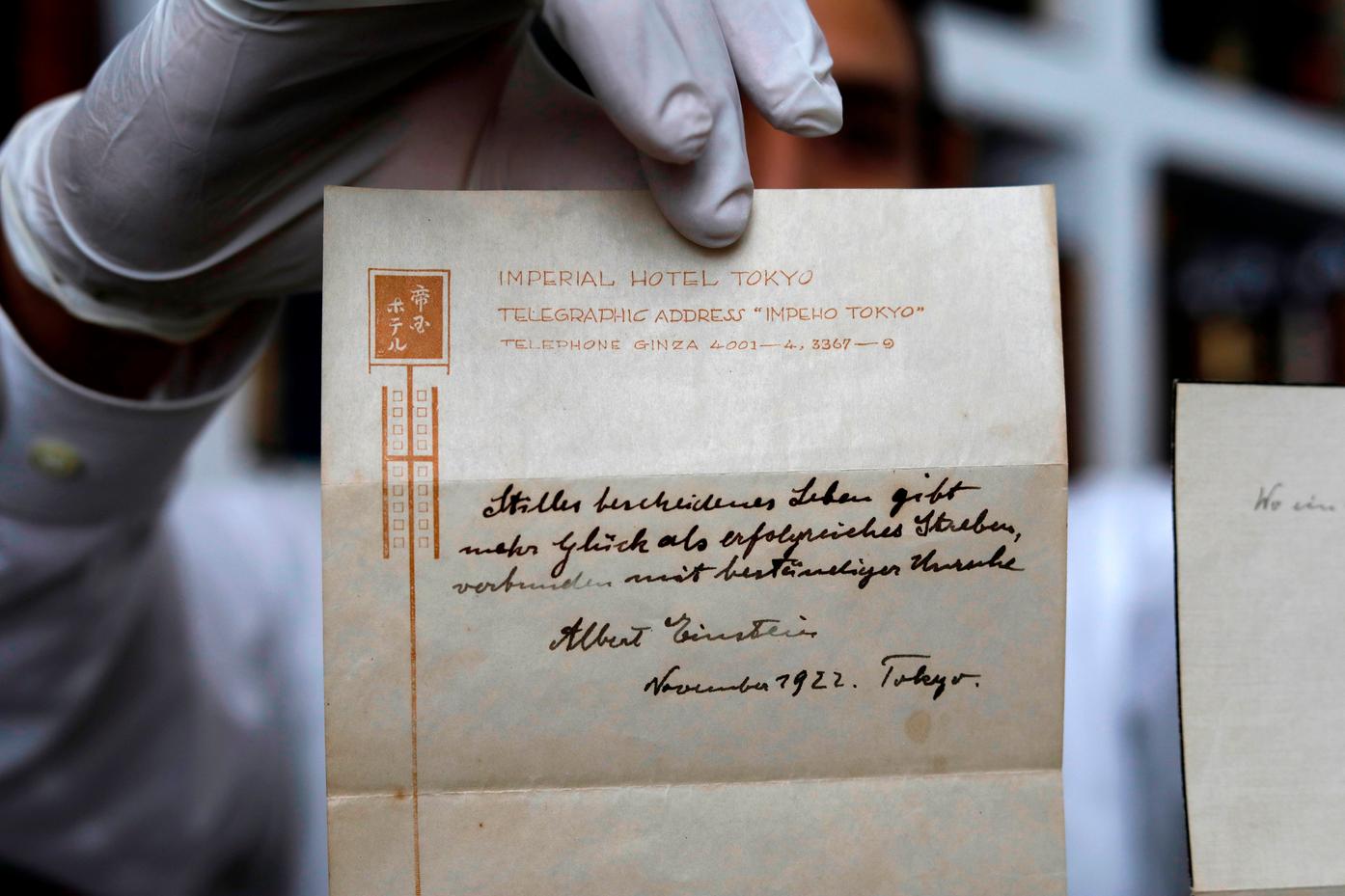
I found an online article that told a story of Einstein giving a piece of advice to bellboy in Tokyo, noting that, "A calm and modest life brings more happiness than the pursuit of success combined with constant restlessness".  I was reminded by Thoreau and Epicureanism, and started to wonder about the connection between Creativity and Happiness, and how Einstein's state of happiness affected his creativity, and how this all contributed to his many incredible scientific discoveries, including the Theory of Relativity.


"A calm and modest life brings more happiness than the pursuit of success combined with constant restlessness,“ advised Einstein to a bellboy at a hotel in Tokyo in 1922.


Sources

 Ratner, P. (2017). Einstein's "Theory of Happiness" teaches a profound truth. Big Think.  Web magazine.  Retrieved from: https://bigthink.com/surprising-science/scientists-solve-leonardo-da-vincis-500-year-old-human-heart-mystery

Hadot, P., Simmons, J.A., & Marshall, M. (2005). There Are Nowadays Professors of Philosophy, but not Philosophers. The Journal of Speculative Philosophy 19(3), 229-237. doi:10.1353/jsp.2005.0021

Wikipedia. Epicureanism Definition.  Retrieved on May 30, 2021 from https://en.wikipedia.org/wiki/Epicureanism

Monday, May 24, 2021

Learning to be Creative


There's no question that creativity is valued and viewed positively in our society, and has been behind many incredible innovations over time, in every industry.  While completing this week's glossary of terms for PME 811,  I wondered to what extent one could LEARN to be CREATIVE, and how much of creativity is innate.

While creativity is included in Bloom's Taxonomy of Learning, he notes that synthesis (creating) is one of the most difficult skills to master because a person has to use all of the other cognitive skills in the creative process.  Creating is the highest order of thinking.  Bloom notes that it should be at the forefront of all learning activity as well as an end goal. 

In an edutopia post, Ben Johnson indicates four interesting ways that educators can develop creativity in students:

1. Set up learning activities that allow students to explore their creativity in relevant, interesting, and worthwhile ways

2. Value creativity and celebrate and reward it

3. Teach students the other skills they need to be creative

4. Remove constraints for creativity and give the students space and a framework in which they can be creative

I believe that like any other skill, creativity can be learned, and similarly to any other skill, there is variance in an individual's ability to acquire the skill or be proficient.  Educators should be encouraged to create a welcoming environment for creativity (which includes a tolerance for failure).


Sources

 Badran, I. (2007). Enhancing creativity and innovation in engineering education. European Journal of Engineering Education, 32(5), 573–585. https://doi.org/10.1080/03043790701433061

Johnson, B. (2019) Edutopia: 4 Ways to Develop Creativity in Students.  Retrieved from: https://www.edutopia.org/article/4-ways-develop-creativity-students