Sunday, May 30, 2021

Innovation and Hallelujah - Revisionist History by Malcolm Gladwell

15 Essential Things You Need to Know to Start Your Music Career

A few of this week's PME 811 readings referenced "revisionist perspectives" or "revisionism".  I was reminded of a podcast that has long been on my "to listen" list, but I've never gotten around to it. Malcolm Gladwell's Revisionist History podcast piqued my interest as I am a big fan of his books The Tipping Point, Blink, and Outliers.

I listened to "Hallelujah" from season one. In this podcast, Gladwell notes that art lover David Gallenson indicates there are two types of innovators

Conceptual Innovators - Those who have meticulously planned and work quickly, have specific ideas, and execute. Example Picasso.  Exemplifies what most people consider when they think of "genius".

Experimental Innovators - Those who never have a clear idea, work by trial and error, do endless drafts, work slowly, take a lifetime to create. Example Cezanne - who was known for 

Gladwell talks about the famous song Hallelujah, originally written by Leonard Cohen. It has since been covered by John Cale, Jeff Buckley, Bon Jovi, and several other artists. I am sure you have heard it. Gladwell tells an interesting story of Cohen (termed an Experimental Innovator who took years to write the song), then the song was made famous by Jeff Buckley, a Conceptual Innovator, 15 years later when it is finally identified as a work of genius.

To relate this to the content I read during our course this week, this illustration of differing degrees of success within innovators makes me reconsider my glossary definition of innovation.  Perhaps innovation requires a purpose, planning and successful execution.


Sources

Gladwell, M. (2016). "Hallelujah" Audio blog post.  Revisionist History. Pushkin, July 28, 2016.

Einstein's "Theory of Happiness", Creativity, and Epicureanism

Albert Einstein

This week, I read "There Are Nowadays Professors of Philosophy, but not Philosophers", as part of  the History and Philosophy of Teaching and Learning module of PME 811.  This article expands on a quote (the article's title) by philosopher Henry David Thoreau.  Thoreau spent some time escaping the trappings of  modern life at the time, to live a simple life in nature.  

The article noted Thoreau's connection to Epicureanism (a word I had to look up, as I too am not a philosopher!). Epicureus was an ancient Greek philosopher. Epicurus believed that the greatest good was to seek modest, sustainable pleasure in the form of a state of ataraxia (tranquility and freedom from fear) and aponia (the absence of bodily pain) through knowledge of the workings of the world and limiting desires. Correspondingly, Epicurus and his followers generally withdrew from politics because it could lead to frustrations and ambitions which can directly conflict with the Epicurean pursuit for peace of mind and virtues.

While seeking ideas for my blog entries for the week, I started thinking about Einstein, one of the most creative minds in history.  Einstein is quoted as saying, "Creativity is more important than intelligence", which I find interesting, and makes me wonder how Einstein would define "intelligence".  

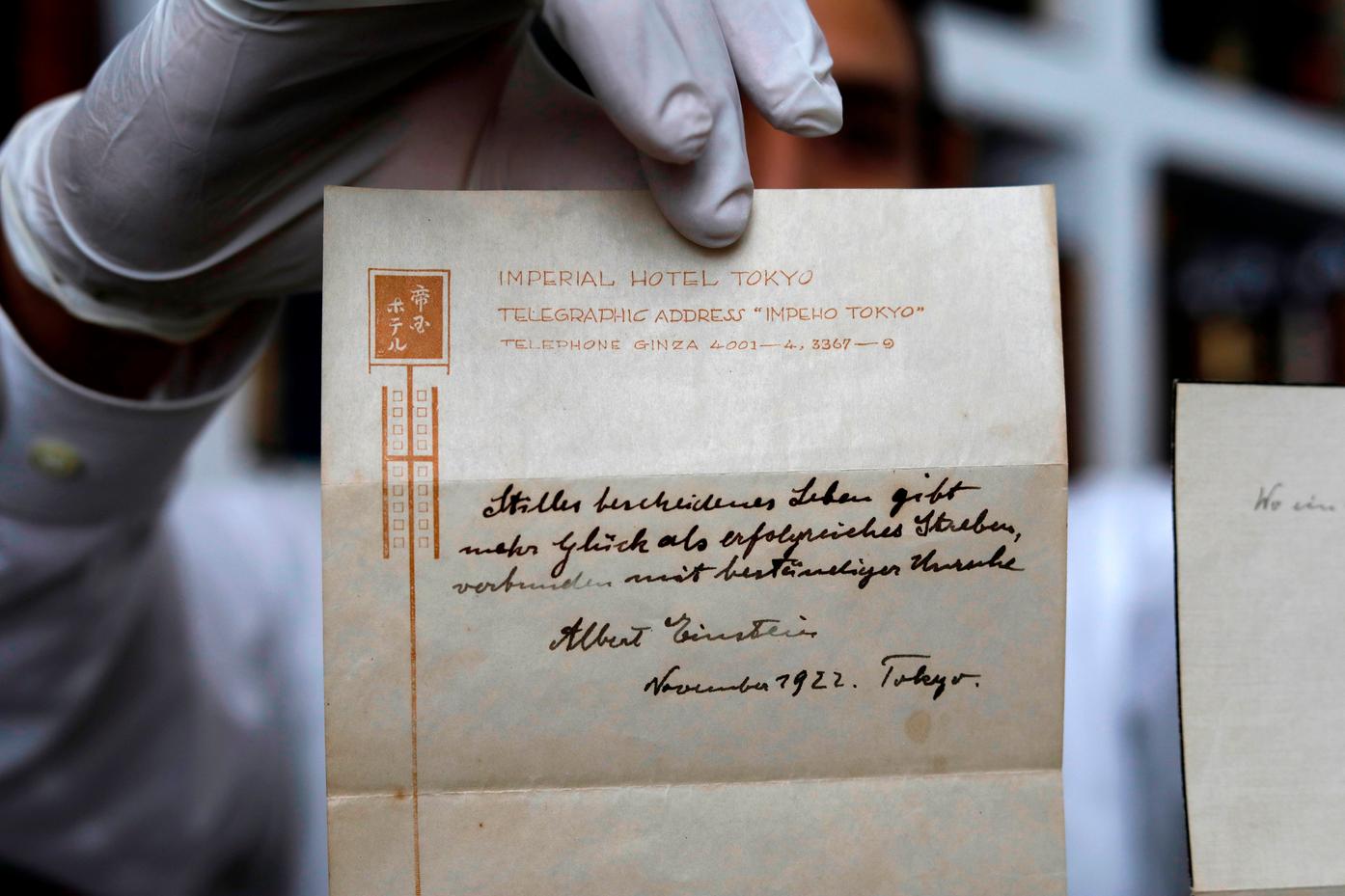
I found an online article that told a story of Einstein giving a piece of advice to bellboy in Tokyo, noting that, "A calm and modest life brings more happiness than the pursuit of success combined with constant restlessness".  I was reminded by Thoreau and Epicureanism, and started to wonder about the connection between Creativity and Happiness, and how Einstein's state of happiness affected his creativity, and how this all contributed to his many incredible scientific discoveries, including the Theory of Relativity.


"A calm and modest life brings more happiness than the pursuit of success combined with constant restlessness,“ advised Einstein to a bellboy at a hotel in Tokyo in 1922.


Sources

 Ratner, P. (2017). Einstein's "Theory of Happiness" teaches a profound truth. Big Think.  Web magazine.  Retrieved from: https://bigthink.com/surprising-science/scientists-solve-leonardo-da-vincis-500-year-old-human-heart-mystery

Hadot, P., Simmons, J.A., & Marshall, M. (2005). There Are Nowadays Professors of Philosophy, but not Philosophers. The Journal of Speculative Philosophy 19(3), 229-237. doi:10.1353/jsp.2005.0021

Wikipedia. Epicureanism Definition.  Retrieved on May 30, 2021 from https://en.wikipedia.org/wiki/Epicureanism

Monday, May 24, 2021

Learning to be Creative


There's no question that creativity is valued and viewed positively in our society, and has been behind many incredible innovations over time, in every industry.  While completing this week's glossary of terms for PME 811,  I wondered to what extent one could LEARN to be CREATIVE, and how much of creativity is innate.

While creativity is included in Bloom's Taxonomy of Learning, he notes that synthesis (creating) is one of the most difficult skills to master because a person has to use all of the other cognitive skills in the creative process.  Creating is the highest order of thinking.  Bloom notes that it should be at the forefront of all learning activity as well as an end goal. 

In an edutopia post, Ben Johnson indicates four interesting ways that educators can develop creativity in students:

1. Set up learning activities that allow students to explore their creativity in relevant, interesting, and worthwhile ways

2. Value creativity and celebrate and reward it

3. Teach students the other skills they need to be creative

4. Remove constraints for creativity and give the students space and a framework in which they can be creative

I believe that like any other skill, creativity can be learned, and similarly to any other skill, there is variance in an individual's ability to acquire the skill or be proficient.  Educators should be encouraged to create a welcoming environment for creativity (which includes a tolerance for failure).


Sources

 Badran, I. (2007). Enhancing creativity and innovation in engineering education. European Journal of Engineering Education, 32(5), 573–585. https://doi.org/10.1080/03043790701433061

Johnson, B. (2019) Edutopia: 4 Ways to Develop Creativity in Students.  Retrieved from: https://www.edutopia.org/article/4-ways-develop-creativity-students 


History of Virtual Learning and B.F. Skinner


Today I was thinking about the history of innovation in teaching and learning and scrolled the internet in search of an interesting article.  I came across this timeline, which outlines the progress that has been made in distance learning since the 1700s.  

From its humble beginnings in the 1700s where lessons were mailed to students to today where live video lessons are delivered to students around the world, teaching and learning has made many significant innovations over time, particularly as it pertains to educational technology.

One piece that caught my eye was B.F. Skinner's "teaching machine".  From my Psychology background, I was familiar with B.F. Skinner's work in operant conditioning, a learning process which leverages reward and punishment to strengthen a behavior response, but I had never heard of the teaching machine!

Building on this work in conditioning, Skinner had created the GLIDER, a teaching machine that uses automated, individualized reinforcement to teach reading and music.  Some say Skinner's invention was the beginning of open learning and computer-assisted instruction.  Could it also be a rudimentary introduction to Artificial Intelligence?  

The concept at work for the GLIDER is Programmed Learning (also referred to as Programmed Instruction).  During programmed learning, the student is presented with learning material with either a text or machine/computer of sorts.  Answers are provided and students are given immediate feedback. I think that vestiges of the GLIDER still exist today in our virtual learning environment where online quizzes are utilized not only to test a student's knowledge, but to reinforce concepts that are often best learned by repetition.


Sources

History of Virtual Learning Environments. Digital image, Retrieved from: http://www.designstorm.in/thoughtstorm/wp-content/uploads/2013/10/HistoryofVLEs_V3c.png

A Hypertext History of Instructional Design. Website.  Retrieved from http://faculty.coe.uh.edu/smcneil/cuin6373/idhistory/pressey.html

Tuesday, May 18, 2021

Technology in Education During COVID-19 (Part II)


Technology in Public Education During COVID-19

I have to say that I am enjoying this method of reflection. As I mentioned in my first post, I initially struggled for something to reflect on.  As I write, I am finding additional questions I want to answer and I hope to include in future posts.  I will mention them as they come to mind.

This post will come in stark contrast to my first. My first post, written from the perspective of an employee of a forward-thinking private post-secondary institution, proudly outlined the readiness of the institution and its students for the COVID-19 pandemic early in 2020. This second post is from the point-of-view of a public school parent of a grade 6 student and a grade 4 student with ASD.

While my children are at the same school, their online learning experiences have been very different.  Speaking only about the teaching aspect (I may want to consider innovations in learning, particularly for students on the Autism spectrum in a future post), I have noticed a lot of variation.  Some educators moved to digital learning fairly quickly, as they already had an arsenal of technology-enabled teaching tools they were using, and knew what to use when. Others had been reluctant to incorporate technology in the classroom pre-pandemic, and struggled to keep up when online learning became a reality.  I have noticed this latter group has come a long way in a year.  I would be interested to hear from longtime educators in this class who have taught through decades, and who could speak to innovation over the years.


I would  take this opportunity to thank the public school educators out there who have been able to keep the educational "lights on" during this pandemic, any way you've been able to make it work - especially those with their own learners at home.  Cheers.  I am very thankful for you all.

Technology in Education during COVID-19 (Part I)


Welcome to my PME 811 - Innovation in Teaching & Learning blog!  I am having challenges in finding just one question to explore during this course, as I have many smaller questions and ideas to flesh out. Perhaps further in the course, a theme will take shape.  I hope you enjoy my musings, and I look forward to reading your comments!

 Technology and COVID-19

Many consider technology and innovation as almost synonymous terms, so it seems like a reasonable place to start my blog on recent innovations in teaching and learning.

For this post I will be focused on technology, post-secondary education and COVID-19.

The COVID-19 pandemic has presented many challenges for education worldwide, especially in Ontario where a third lockdown is being experienced.  It can also be said that unique opportunities have been presented.  Institutions and boards whose digital or online offering was not polished and prepared were forced to pivot and implement technology-based solutions almost overnight.


Dean's Innovation Fund


At the Smith School of Business where I work, we were fortunate to have most of the technological infrastructure in place to support online learning when it was needed.  Many of our course and program offerings were already available via videoconferencing or on-demand online. The remainder of in-person courses were delivered digitally in a matter of days. The Smith School of Business Centre for Excellence in Teaching and Learning has been erected as a positive side effect of the pandemic. This can be attributed not only to the physical readiness of the institution for digital delivery, but also an institutional commitment to innovation, a concept which I may explore in a future post. 

For postsecondary and adult learning, this readiness is not uncommon. As these institutions try to keep pace with the needs of customers, providing flexible learning options has become more prevalent.  Online courses such as EdX, Coursera, and Linkedin Learning have been gaining popularity in the last decade. Postsecondary and adult learners have also been prepared as most are equipped with the technology and skills required to participate in digital learning.  Most possess a smartphone, tablet, laptop, and access to high-speed internet. It should be recognized that a certain amount of privilege is assumed here, which I would like to discuss in another post later in this course.