
This week, I read "There Are Nowadays Professors of Philosophy, but not Philosophers", as part of the History and Philosophy of Teaching and Learning module of PME 811. This article expands on a quote (the article's title) by philosopher Henry David Thoreau. Thoreau spent some time escaping the trappings of modern life at the time, to live a simple life in nature.
The article noted Thoreau's connection to Epicureanism (a word I had to look up, as I too am not a philosopher!). Epicureus was an ancient Greek philosopher. Epicurus believed that the greatest good was to seek modest, sustainable pleasure in the form of a state of ataraxia (tranquility and freedom from fear) and aponia (the absence of bodily pain) through knowledge of the workings of the world and limiting desires. Correspondingly, Epicurus and his followers generally withdrew from politics because it could lead to frustrations and ambitions which can directly conflict with the Epicurean pursuit for peace of mind and virtues.
While seeking ideas for my blog entries for the week, I started thinking about Einstein, one of the most creative minds in history. Einstein is quoted as saying, "Creativity is more important than intelligence", which I find interesting, and makes me wonder how Einstein would define "intelligence".
I found an online article that told a story of Einstein giving a piece of advice to bellboy in Tokyo, noting that, "A calm and modest life brings more happiness than the
pursuit of success combined with constant restlessness". I was reminded by Thoreau and Epicureanism, and started to wonder about the connection between Creativity and Happiness, and how Einstein's state of happiness affected his creativity, and how this all contributed to his many incredible scientific discoveries, including the Theory of Relativity.
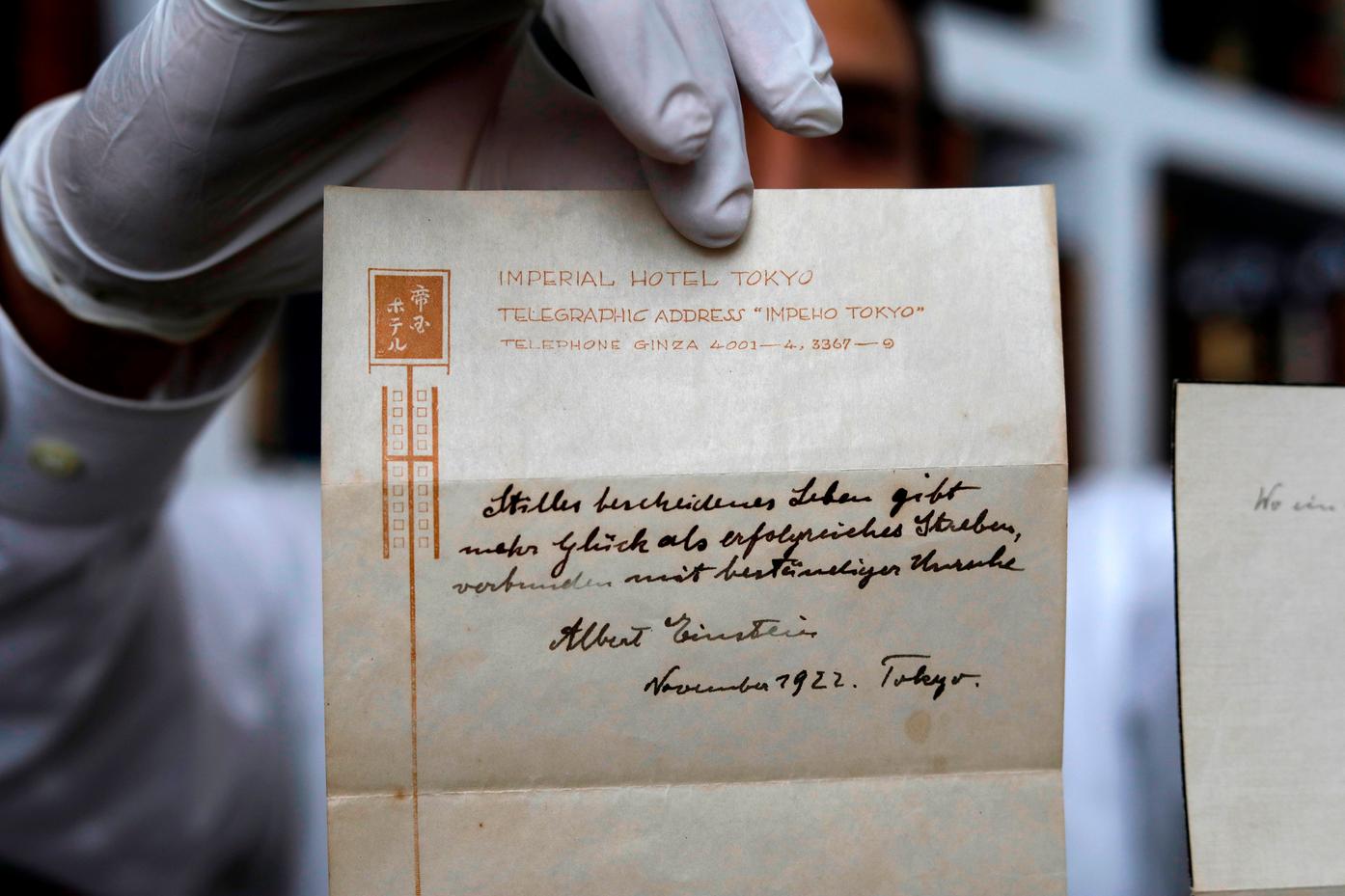
"A calm and modest life brings more happiness than the
pursuit of success combined with constant restlessness,“ advised Einstein to a bellboy at a hotel in Tokyo in 1922.
Sources
Ratner, P. (2017). Einstein's "Theory of Happiness" teaches a profound truth. Big Think. Web magazine. Retrieved from: https://bigthink.com/surprising-science/scientists-solve-leonardo-da-vincis-500-year-old-human-heart-mystery
Hadot, P., Simmons, J.A., & Marshall, M. (2005). There Are Nowadays Professors of Philosophy, but not Philosophers. The Journal of Speculative Philosophy 19(3), 229-237. doi:10.1353/jsp.2005.0021
Wikipedia. Epicureanism Definition. Retrieved on May 30, 2021 from https://en.wikipedia.org/wiki/Epicureanism


Wow! I love the quote "A calm and modest life brings more happiness than the pursuit of success combined with constant restlessness." We are always on the go, trying to do more, earn more, and be better. The issue with this is we never take the time to appreciate who we already are and celebrate what we have done. Thank you for your interesting post, I really enjoyed reading it.
ReplyDeleteKaren
Thanks Karen.
ReplyDeleteI agree, though it is difficult in a capitalist society that promotes and rewards always striving to have more and do more to take time to "smell the roses", be appreciative and gracious. I don't believe it's an "all or nothing" proposition, however. We can take this bit of sage advice and weave it into our capitalist lives as appropriate :)
Hi Tiffany,
ReplyDeleteI enjoyed reading your blog and after a long time, I revisited the quote by Einstein. With my life experiences, now I have realized there is not one way to lead life. With some people this quote might be true but with others they might be struggling with this idea. I believe we have to justify our potentials and do our best in every situation. Leave the outcomes. That brings calm and modesty to me.
Best,
Saira